Before this trip we had been to Istanbul before, very very briefly last summer. The Mediterrean cruise we went on last summer stopped for a half day in Istanbul and we did a 4-5 hour tour of the city. It was August so it was very hot and we quickly realized that Istanbul is a big vacation spot for Europeans.
When planning this world-trip, Chris knew he wanted to come back to Istanbul. Kate wasn't so sure but agreed to the stop anyways. Now that we've spent almost a week here, Kate claims this was her favorite stop on the trip so far! Good thing Chris added it to the itinerary! We were there in June (even though we're writting this post in August!) so the weather was the perfect and having the breeze from the sea was amazing. Such a change from hot Dubai and humid India!
The Food:
SO much amazing seafood! And the doner (smoked lamb on a stick) is to die for. Chris is a huge fan of the famous Turkish (but also claimed by the Greeks) dessert, Baklava. Kate preferred the sweet, chewy Turkish delights. This was also the first place on our trip where we could get good wine and at a fairly reasonable price. Asia does not have much good wine and the good wine they do have is really expensive. Breakfasts here are better but not great or filling. It's breads, meats, cheeses - very European.
The people:
Istanbul is a very touristy town so the people are used to tourists roaming the streets. Most of the people working the restaurants, hotels, and tourist sites speak English. There's also plenty of English speaking tours given at each site. However, it can be limited and we definitely had some cab drivers that didn't speak any. The people in Istanbul are very nice. The last time we were in Istanbul we had a tour guide we really liked so we met up with her on this trip. She wasn't available to take us on a tour of the sites but we did get to meet up with her for coffee. It's always fun to meet people that live in the cities that you visit.
Religion:
In the middle-east and in Turkey, religion is very important to the people living there. Several times a day we heard the call to prayer ring through the streets and outside our hotel room. It's interesting to experience this very prominent practice of religion. It's always nice to experience other spiritual rituals but when it's something that in-your-face everyday, it makes us happy to live in a country where one religion isn't pushed on you. Where you can practice, or not practice, any religion that you choose.
In summary, Istanbul is truely a unique and incredible city. It's geographically the center of world. It's where Europe meets Asia across a stretch of water a few hundred meters wide. The only city that exists in two continents. Istanbul is also very easy to get around and it's a historic town with a relaxed beach vibe. We highly recommend that you visit. We also recommend our hotel: Hotel Tashkonak Istanbul. It was centrally located, in a nice and very European-looking neighborhood. And the staff were some of the nicest people.
Sunday, August 14, 2011

Saturday, August 6, 2011
Istanbul - Day 4
Our forth day in Istanbul felt like such a blessing. The night before we misread our schedule and thought we were leaving the next morning. So on our fourth day in Istanbul, we packed our bags and headed down to check-out but we were quickly sent back upstairs by reception. Apparently we had one more full day in Istanbul! We were so excited because, you may recall, our first day in Istanbul we tried to see the Dolmabahce Palace but the line was too long. We made sure that was our first stop on our last day.
The Dolmabahce Palace was the administrative center of the late Ottoman Empire with the last of Ottoman Sultans residing there. After the foundation of the Turkish Republic in Ankara, Mustafa Kemal Ataturk transferred all government functions to the youthful capital but on his visits to Istanbul Ataturk occupied only a small room at Dolmabahce Palace as his own. He stayed, welcomed his foreign guests and made a practical center for national, historical and language congress and for international conferences.
Dolmabahce Palace has a signficant meaning for the Turkish people as Mustafa Kemal Ataturk had used the palace as a residence and he died in this palace on November 10, 1938 at 9:05 A.M. All the clocks in the palace are stopped to mark this time.
Unfortunately, the palace's status as a royal residence precludes the taking of pictures inside, but we did take many pictures outside.


We also visited the Harem and Crystal Staircase inside the Palace walls but, again, we weren't allowed to take pictures. Outside the Crystal Staircase were many types of birds: roosters, chickens, and peacocks.

After the Dolmabache Palace, we went to Taksim Square to walk around and grab lunch.

As we made our way back to our hotel, we took this very steep street. It doesn't look as steep in this picture as it was. Another odd thing about this street, there were multiple guitar stores.

Like many big cities, there's tons of street food in Istanbul: watermelon, corn on the cob and candy. Since this was our last day, Chris tried the very unusual candy on a stick.

The Dolmabahce Palace was the administrative center of the late Ottoman Empire with the last of Ottoman Sultans residing there. After the foundation of the Turkish Republic in Ankara, Mustafa Kemal Ataturk transferred all government functions to the youthful capital but on his visits to Istanbul Ataturk occupied only a small room at Dolmabahce Palace as his own. He stayed, welcomed his foreign guests and made a practical center for national, historical and language congress and for international conferences.
Dolmabahce Palace has a signficant meaning for the Turkish people as Mustafa Kemal Ataturk had used the palace as a residence and he died in this palace on November 10, 1938 at 9:05 A.M. All the clocks in the palace are stopped to mark this time.
Unfortunately, the palace's status as a royal residence precludes the taking of pictures inside, but we did take many pictures outside.
 |
| The clock out front |
 |
| The entrance |


 |
| The gate of the Sultan |


 |
| View of the city |
 |
| Chris took time to smell the roses in the garden |

We also visited the Harem and Crystal Staircase inside the Palace walls but, again, we weren't allowed to take pictures. Outside the Crystal Staircase were many types of birds: roosters, chickens, and peacocks.
 |
| The back of a peacok. It didn't want to turn around for us. |

After the Dolmabache Palace, we went to Taksim Square to walk around and grab lunch.

 |
| Galata Tower |

Like many big cities, there's tons of street food in Istanbul: watermelon, corn on the cob and candy. Since this was our last day, Chris tried the very unusual candy on a stick.

Thursday, August 4, 2011
Istanbul - Day 3
Having gotten our bearings on the city the first two days, we ventured out on our own the third day in Istanbul. We started with the Topkapi Palace which took most of our day to visit.
The Topkapı Palace was the main residence of the sultan and his court. It was initially the seat of government as well as the imperial residence. Even though access was strictly regulated, inhabitants of the palace rarely had to venture out since the palace functioned almost as an autonomous entity, a city within a city. The palace is a complex made up of four main courtyards and many smaller buildings. At the height of its existence as a royal residence, the palace was home to as many as 4,000 people. Needless to say, there was a lot to see.


Next, we ventured onto the Basilica Cistern. This underground complex is the largest of several hundred ancient cisterns that lie beneath the city of Istanbul. The cistern, located just southwest of the Hagia Sophia, was built in the 6th century during the reign of Emperor Justinian I. Before being converted to a cistern (a reservoir for water), a great Basilica stood in its place.
This cathedral-size cistern is an underground chamber approximately about 105,000 square feet in area - capable of holding 2,800,000 cubic feet of water.


The ceiling is supported by a forest of 336 marble columns, each 30 feet high, arranged in 12 rows of 28 columns each spaced 16 feet apart. One of the columns is engraved with raised pictures of a Hen's Eye, slanted branches, and tears. This column resembles the columns of the Triumphal Arch of Theodosius I from the 4th century (AD 379-395). Ancient texts suggest that the tears on the column pay tribute to the hundreds of slaves who died during the construction of the Basilica Cistern.

Located in the northwest corner of the cistern, the bases of two columns reuse blocks carved with the visage of the Medusa. The origin of the two heads is unknown and there is no written evidence that suggests they were used as column pedestals previously. Tradition has it that the blocks are oriented sideways and inverted in order to negate the power of the Gorgon's gaze.
According to popular myth, Medusa was one of the three Gorgons, the terrifying female creatures from Greek Mythology. Legend has it that Medusa, with her hair of snakes, could turn anyone who looked at her into stone, and therefore images of Gorgons were used to protect great buildings.
Another version of the story claims that Medusa was the only mortal Gorgon, a beautiful girl with long hair and dark eyes who had long been in love with Perseus, the son of Zeus. Athene, also in love with Perseus, turned Medusa's hair into snakes in a jealous rage. From then on, every person Medusa looked at was petrified. After learning of Medusa's curse, Perseus beheaded her, taking her head to war with him and turning his enemies into stone. It is said that many Byzantium era sword handles and columns were engraved with her head upside down.


We had been in Istanbul last summer and one of Kate's favorite sites was the Blue Mosque. We had some time left in the day so we headed over for a few more pictures. The Blue Mosque is the only mosque in Istanbul with 6 pillars, instead of 4. It is one of the most beautiful and recognizable monuments in Istanbul.


Right across from the Blue Mosque is the Hagia Sophia, other site we visited last summer but loved so much we went over to grab a picture.

After a very long day of touring, it was time to have some baklava and turkish delight. The most delicious part of the day.

The Topkapı Palace was the main residence of the sultan and his court. It was initially the seat of government as well as the imperial residence. Even though access was strictly regulated, inhabitants of the palace rarely had to venture out since the palace functioned almost as an autonomous entity, a city within a city. The palace is a complex made up of four main courtyards and many smaller buildings. At the height of its existence as a royal residence, the palace was home to as many as 4,000 people. Needless to say, there was a lot to see.
 |
| Entrance Gate |
 |
| The kitchens |

 |
| The library |

 |
| View of the Bosporus from the palace |

 |
| The Audience Chamber |
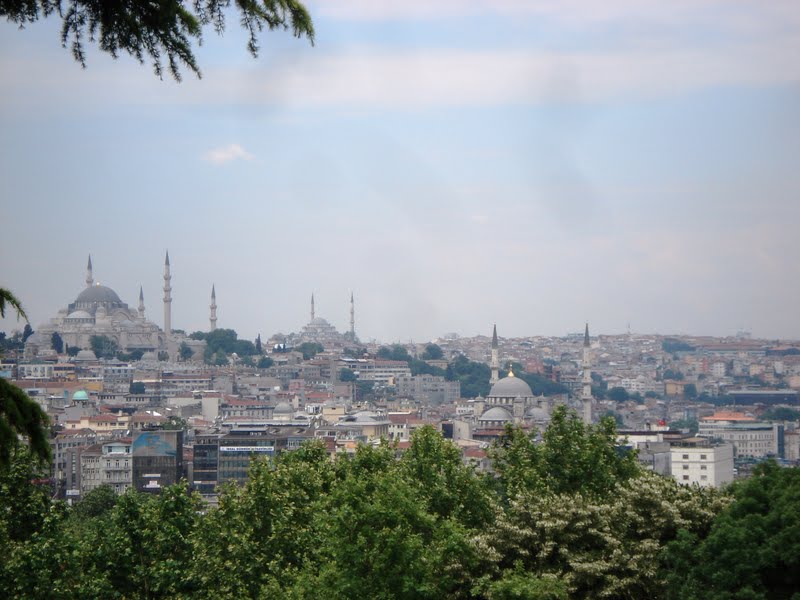 |
| The view looking at the mosques in Istanbul. |


 |
| Such an amazing ceiling |


 |
| We did the audio tour of the palace (inside the Harem) |


 |
| Door decorated with mother of pearl |
 |
| Courtyard of apartments of the Queen Mother |
 |
| SO much blue tile. |

 |
| Stained glass windows |

 |
| View from the outside, the windows wide open |
 |
| Kate in the Courtyard of the Favourites |
Next, we ventured onto the Basilica Cistern. This underground complex is the largest of several hundred ancient cisterns that lie beneath the city of Istanbul. The cistern, located just southwest of the Hagia Sophia, was built in the 6th century during the reign of Emperor Justinian I. Before being converted to a cistern (a reservoir for water), a great Basilica stood in its place.
This cathedral-size cistern is an underground chamber approximately about 105,000 square feet in area - capable of holding 2,800,000 cubic feet of water.

 |
| Huge fish |


The ceiling is supported by a forest of 336 marble columns, each 30 feet high, arranged in 12 rows of 28 columns each spaced 16 feet apart. One of the columns is engraved with raised pictures of a Hen's Eye, slanted branches, and tears. This column resembles the columns of the Triumphal Arch of Theodosius I from the 4th century (AD 379-395). Ancient texts suggest that the tears on the column pay tribute to the hundreds of slaves who died during the construction of the Basilica Cistern.

Located in the northwest corner of the cistern, the bases of two columns reuse blocks carved with the visage of the Medusa. The origin of the two heads is unknown and there is no written evidence that suggests they were used as column pedestals previously. Tradition has it that the blocks are oriented sideways and inverted in order to negate the power of the Gorgon's gaze.
According to popular myth, Medusa was one of the three Gorgons, the terrifying female creatures from Greek Mythology. Legend has it that Medusa, with her hair of snakes, could turn anyone who looked at her into stone, and therefore images of Gorgons were used to protect great buildings.
Another version of the story claims that Medusa was the only mortal Gorgon, a beautiful girl with long hair and dark eyes who had long been in love with Perseus, the son of Zeus. Athene, also in love with Perseus, turned Medusa's hair into snakes in a jealous rage. From then on, every person Medusa looked at was petrified. After learning of Medusa's curse, Perseus beheaded her, taking her head to war with him and turning his enemies into stone. It is said that many Byzantium era sword handles and columns were engraved with her head upside down.


Outside of the Basilica Cistern lies the remains of the "Million Stone". The Million Stone was always put in the center of the city and distances to all corners of the Byzantine Empire were once measured starting from this point. The stone was erected under the reign of Constantine the Great around 4th century AD, marking the starting point of an extensive road network.
 |
| The top of the Basilica Cistern |


 |
| Chris inside the Blue Mosque |


Right across from the Blue Mosque is the Hagia Sophia, other site we visited last summer but loved so much we went over to grab a picture.
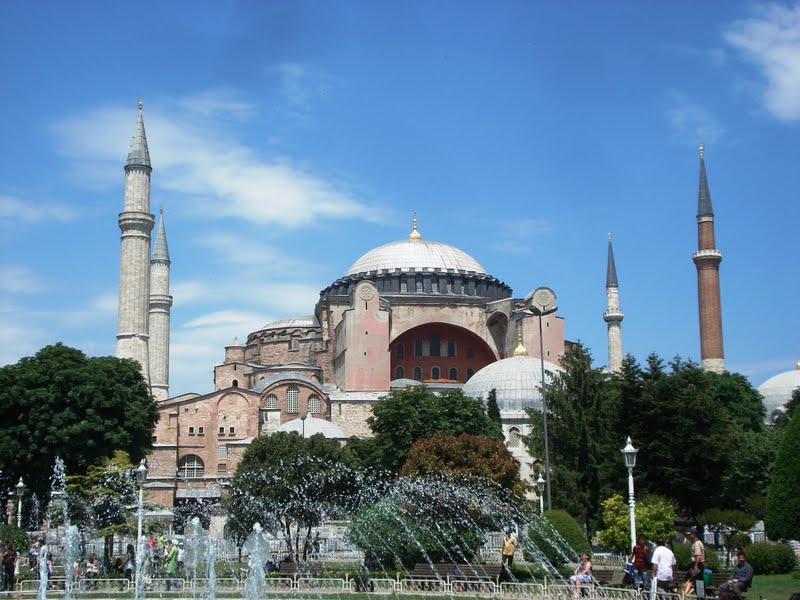
After a very long day of touring, it was time to have some baklava and turkish delight. The most delicious part of the day.

Subscribe to:
Posts (Atom)